
Medically Reviewed By Sonam Kothari, Written By Tejasvi Parekh
A comprehensive picture of the world around us is produced by the sophisticated sense of vision, which combines both central and peripheral sight. Peripheral vision records the larger background, allowing us to detect movements and preserve spatial awareness, while central vision enables us to concentrate directly on particular details.
However, there is frequently a distinct propensity for people with autism to rely more on peripheral vision, along with a reluctance to make direct eye contact or perception.
Both academics and carers have been interested in this phenomena, where people may glance "out of the corner of their eyes" or focus on their surroundings indirectly. It calls into question how variations in sensory processing in autism affect how visual information is prioritised and interpreted.
For some, this preference for peripheral vision may serve as a coping mechanism to avoid the overwhelming intensity of direct visual stimuli, while for others, it could reflect differences in neural processing pathways.
This article examines the possible causes, consequences, and effects of autism on social interaction, learning, and sensory experiences in relation to peripheral vision. By comprehending this distinct visual inclination, we may cultivate increased empathy and create plans to help people with autism navigate their environment more effectively.
Peripheral vision plays a significant role in how individuals with autism perceive and interact with the world. Certain behaviors and patterns observed in individuals on the autism spectrum highlight the unique ways peripheral vision is utilized. Below are the key characteristics:
Instead of using their centre vision, many people with autism choose to rely on their peripheral vision. This frequently takes the form of side-glancing or studying people and things out of the corner of their eyes. Since peripheral vision processes information differently and less intensively than central vision, this behaviour might help people feel less overwhelmed by sensory stimulation.
Avoidance of eye contact is a well-documented characteristic in autism. This behavior may be partly due to hypersensitivity to direct visual stimuli, making central vision overwhelming or even uncomfortable. Using peripheral vision instead allows individuals to engage visually without the intensity associated with direct gaze.
Visual stimming involves repetitive movements or visual behaviors to regulate sensory input or provide comfort. Examples include:
These behaviors can serve as a coping mechanism for sensory processing challenges or as a means of self-regulation.
Peripheral vision reliance can also be seen in behaviors such as:
Spinning: Observing objects while spinning provides a predictable and calming sensory experience.
Lining Up Objects: This repetitive action may help create visual order and reduce sensory overload.
Laying Down to View Toys: Some children lay on the ground and observe toys or objects from specific angles, often engaging their peripheral vision for comfort and sensory modulation.
Different people with autism have different visual sensory sensitivity:
Hyper-sensitivity: Some people may avoid direct eye contact and rely more on peripheral vision because they perceive central vision to be overstimulating.
Hypo-sensitivity: Some people may have trouble focussing or immediately monitoring objects because they are unable to interpret visual inputs well.
The necessity for personalised strategies to comprehend and assist visual variations in autism is highlighted by this range of sensitivity.
These traits highlight the distinct ways that people with autism interpret visual stimuli. Despite being frequently disregarded, peripheral vision is essential to comprehending the sensory and behavioural patterns seen in autism.
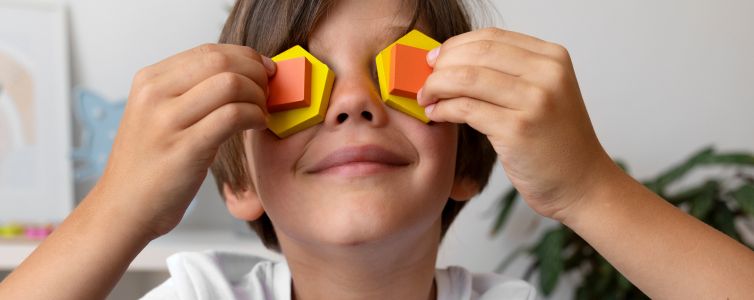
Peripheral vision is frequently more important to autistic people than centre vision. Their bodies and brains' processing of visual information may be the cause of this for a number of reasons. Here are the primary causes, with a brief explanation:
For some people with autism, looking directly at things using their central vision can feel overwhelming or even uncomfortable:
Overload of Information: Central vision gathers a lot of detailed information at once, which can lead to sensory overload. This makes it hard for the brain to process everything clearly, causing what feels like "fragmented" or jumbled perception.
Avoiding Pain or Discomfort: Direct vision can feel too intense, so using peripheral vision may feel more soothing and less stressful.
Certain brain and body differences can affect how visual information is processed:
Visual Motor Planning: Some individuals may have difficulty coordinating their vision with movements, making central vision harder to use efficiently.
Energy Challenges: Problems like mitochondrial dysfunction (issues with energy production in the body) can make it harder for the brain to process visual details properly.
Cell Danger Response: Damaged G proteins in the body (which help with cell communication) may disrupt how the brain handles vision, leading to more reliance on peripheral vision.
Methylation is a process that affects how the body uses vitamins and builds healthy tissues, including the nervous system. When this process doesn’t work well, it can cause:
Problems with Myelination: Myelin is a protective coating around nerves, including the optic nerve. If this coating isn’t strong, visual signals from the eyes to the brain can get disrupted.
Difficulty with Moving Objects: Processing dynamic, or moving, visual information becomes harder, so peripheral vision might be used more as a coping strategy.
By understanding these underlying causes, we can better support individuals with autism in managing their unique visual needs.
Individuals with autism often rely on their side, or peripheral, vision rather than looking directly at objects or people. Their behaviour, language development, and social relationships are just a few of the areas of their lives that may be greatly impacted by this inclination.
Since it facilitates the expression of intents and feelings, direct eye contact is an essential part of social communication.However, a lot of people with autism avoid direct eye contact because they find it overwhelming or uncomfortable.
Effective interpersonal communication depends on the ability to recognise and interpret subtle social cues and facial emotions, which might be hampered by this avoidance.
Consequently, individuals with autism may struggle with understanding others' emotions, leading to challenges in forming and maintaining social relationships.
This reliance on peripheral vision can also contribute to a sense of disconnection during interactions, as they may appear disengaged or uninterested, further complicating social integration.
It is essential for language acquisition, particularly in early childhood, to see mouth movements during speech. Children learn to accurately mimic and produce language by seeing the formation of sounds. These visual cues may be missed by autistic people who avoid direct eye contact, which makes verbal communication skills development more difficult.
This may lead to delays in speech development and difficulty in understanding the rhythm and flow of conversation. Secondly, being bothered by direct eye contact may deter people from engaging in verbal exchanges, thereby retarding the development of language.
Because direct visual engagement can cause discomfort or overstimulation, people with autism may resort to repetitive behaviours, or "stimming," as a coping strategy. These actions, such rocking or flapping one's hands, give one a sense of control and assist control sensory input.
An overdependence on peripheral vision, however restricts exposure to novel situations and educational opportunities; such may potentially impact cognitive developments.
For example, avoiding taking part in immediate visual involvement often causes one to miss crucial cues within the setting, which ultimately may lead to miscommunications and delayed reactions.
Moreover, one may avoid particular settings or move away from the social environment through the fear accompanied by direct perception, which consequently limits their exposure and interaction, thus disengaging them, which in return can trigger vicious cycles where decreased involvement leads to fewer learning and socialization chances, which may further affect both behavioral and cognitive development.
The unique reliance on peripheral vision in individuals with autism highlights the complexity of sensory processing differences that shape how they experience the world. This tendency, which may serve as a coping mechanism or reflect neurological differences, significantly impacts social interactions, language development, and behavior.
Understanding and addressing this tendency is crucial for developing effective support strategies to enhance the quality of life for those on the autism spectrum.
While peripheral vision offers a way to navigate overwhelming sensory inputs, it can also create challenges in communication and learning. Fortunately, therapeutic approaches such as vision therapy, which aims to enhance visual processing and coordination, and other sensory integration therapies, are available to help individuals with autism develop more effective strategies for managing sensory overload.
These therapies can provide tailored support to improve both visual and social functioning, ultimately fostering better outcomes and helping individuals engage more confidently with their environment.